Why Is Fairlife Milk So Expensive? in 2026
If you have ever compared Fairlife milk with regular milk at the grocery store, you may have noticed that Fairlife often costs more. That naturally raises the question: Why is Fairlife milk so expensive? The answer is not simply the brand name. Fairlife uses a specialized filtration process, different production methods, and packaging that help create a milk with a different nutritional profile.
For many shoppers, the higher price may make sense because of the features they are looking for. For others, regular milk may still offer better value.
Why Is Fairlife Milk So Expensive
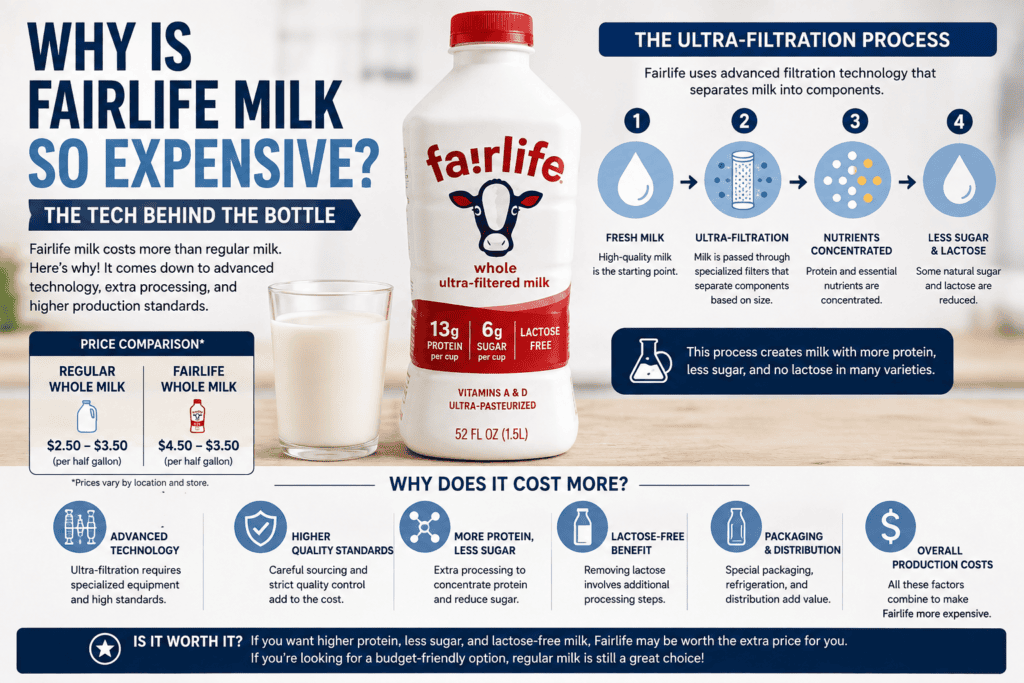
Fairlife milk usually costs more than regular milk because it uses ultra-filtration technology and additional processing. This process helps create milk with higher protein and, in many varieties, less sugar and no lactose. Fairlife also requires specialized equipment, quality control, packaging, refrigeration, and distribution
which can add to the overall cost. For shoppers who value higher protein, lactose-free options, and a smooth texture, the extra price may be worth it; however, regular milk can still be a more budget-friendly choice for everyday use.
What Makes Fairlife Milk Different?
One of the biggest differences is Fairlife’s ultra-filtration process. Instead of selling milk in exactly the same form as traditional milk, Fairlife processes the milk through specialized filtration.
The process separates some components of milk while concentrating others. This allows Fairlife to create products with higher protein and lower sugar than many traditional milk products.
Fairlife also offers lactose-free milk, which can be another reason shoppers choose it over conventional dairy milk.
The Technology Behind the Bottle
Ultra-filtration is an important part of Fairlife’s production process. Milk passes through specialized membranes that separate components based on factors such as size.
This allows certain components to remain or become more concentrated while others are reduced or separated. The resulting milk can then be formulated to provide the nutritional characteristics listed on the package.
This technology requires specialized equipment and additional processing compared with conventional milk production. Those extra steps can contribute to the final retail price.
Why Does More Protein Matter?
One of Fairlife’s most noticeable features is its protein content. Depending on the product, Fairlife milk can provide significantly more protein per serving than traditional milk.
For example, Fairlife’s Whole Milk lists 13 grams of protein per cup, while traditional whole milk commonly provides around 8 grams.
For shoppers who want more protein from the foods they already consume, this difference can make Fairlife more attractive.
What About the Lower Sugar?
Fairlife’s filtration process also allows the company to produce milk with less sugar than many conventional milk products.
Fairlife Whole Milk, for example, lists 6 grams of total sugar per cup. Traditional whole milk commonly contains around 12 grams of sugar per cup.
The exact nutrition varies between products, so it’s always best to check the current package label before making a comparison.
Fairlife Is Also Lactose-Free
Another feature that can contribute to Fairlife’s appeal is its lactose-free formulation.
Regular dairy milk naturally contains lactose. Fairlife offers lactose-free products, making them an option for people who want dairy milk without lactose.
Producing and processing a specialized lactose-free product can involve additional steps compared with conventional milk, which can also contribute to the overall cost.
Does Packaging Affect the Price?
Packaging is another part of the cost of any packaged food product. Fairlife uses distinctive bottles designed to protect and contain its milk products throughout distribution and storage.
The cost of packaging, transportation, refrigeration, manufacturing, and retail distribution all contribute to the price shoppers see on the shelf.
However, it would be inaccurate to say that packaging alone is responsible for Fairlife’s higher price. The overall production process includes many different costs.
Fairlife vs. Regular Milk: Why the Price Difference?
Here is a simple way to look at it:
| Feature | Fairlife | Regular Milk |
|---|---|---|
| Ultra-filtered | Yes | Usually no |
| Protein | Higher in many varieties | Usually lower |
| Sugar | Lower in many varieties | Usually higher |
| Lactose-free options | Yes | Usually contains lactose |
| Processing | More specialized | More traditional |
| Price | Usually higher | Usually lower |
Exact nutrition and prices vary by product, brand, store, and location.
Is Fairlife Milk Worth the Extra Money?
Whether Fairlife is worth the extra price depends on what you want from your milk.
If you value higher protein, lower sugar, lactose-free dairy, and an ultra-filtered product, paying more may make sense for you.
On the other hand, if you simply want traditional milk for cereal, cooking, baking, or everyday drinking, regular milk can be a more economical choice.
The best approach is to compare the price per serving rather than only looking at the price of the bottle.
Final Verdict
So, why is Fairlife milk so expensive? The main reasons are its specialized ultra-filtration process, additional processing, lactose-free formulations, packaging, and overall production and distribution costs.
Fairlife is not necessarily the best choice for everyone, but its higher price comes with features that are different from standard milk. If those features are important to you, the extra cost may be worthwhile. If not, regular milk can still be a simple and budget-friendly option.
Tip: Before buying, compare the current nutrition label and price of Fairlife with your usual milk. That makes it easier to decide whether the benefits are worth the extra money for your needs.